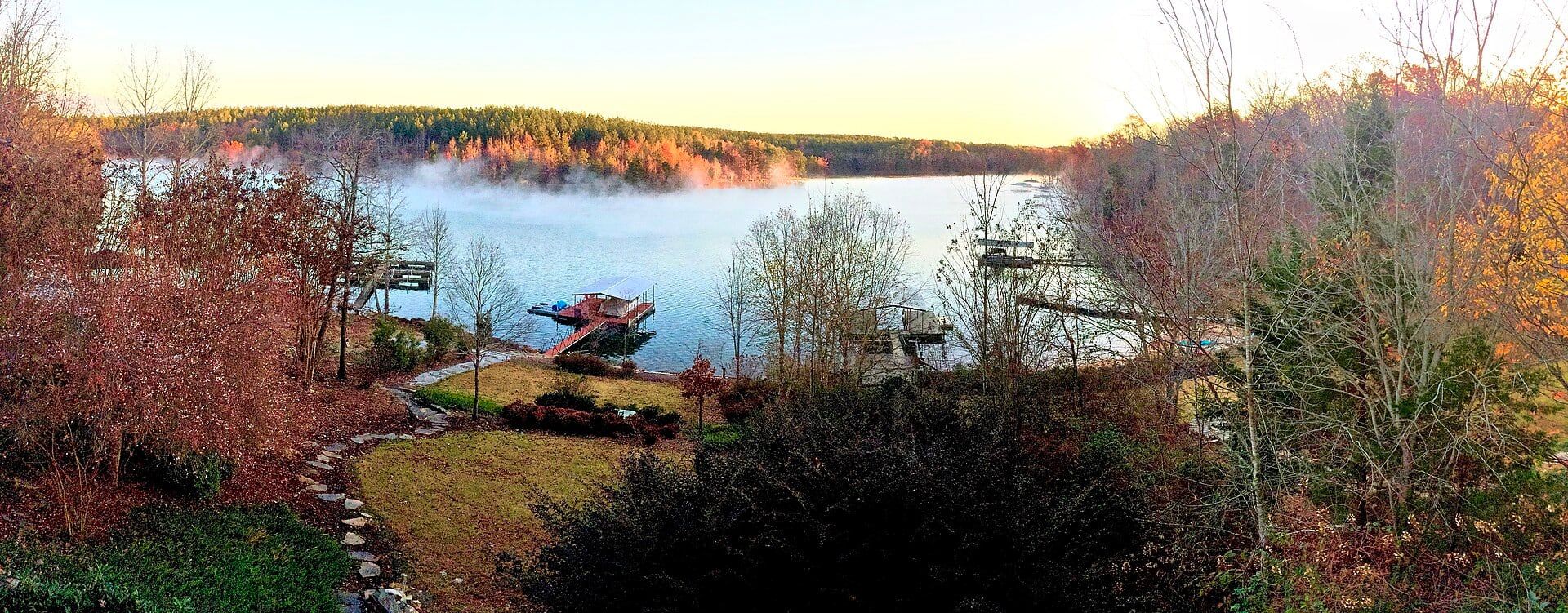
A worn dock on Lake Keowee or Lake Hartwell can often be repaired. The question is whether the repair is worth it, which comes down to cost, the state of the frame, and today’s rules. Here is how to think it through, with ballpark prices for the common jobs.
When should you replace a dock instead of repairing it?
Replace it when the repair would cost more than about half the price of a new dock. That rule of thumb comes from Angi’s cost guide.
To use it, you need two numbers. The first is the repair, and the table below gives ballpark ranges. The second is a new dock of the same size, which we price as a ballpark of $40–$60 per square foot of deck, plus the walkway, any roof and any lift. Our dock cost guide for Keowee and Hartwell walks through that sum.
A dock with one tired part is a repair. A dock that needs floats, decking and cables in the same year is nearer the half-cost line, because the frame under them is just as old.
What wears out on a dock, and what does it cost?
Floats, decking, cables and anchors wear first, then walkway hinges, roof panels and lift parts. These are ballpark ranges, not quotes: the real figure depends on access, size and what turns up once the old part comes off.
| Repair | Ballpark range |
|---|---|
| Replace a float | $150–$400 per float |
| New decking | $25–$55 per sq ft |
| Cables, anchors or re-leveling | $300–$1,800 |
| Walkway or gangway repair | $800–$3,500 |
| Roof repair | $300–$2,500 |
| Boat lift service | $250–$1,500 |
| Smallest repair visit | $350 |
For comparison, national cost guides put floats at $100 to $400 each installed and re-decking at $25 to $55 a square foot. Angi puts a typical dock repair job at $889 to $5,929.
Floats
A float that has cracked or taken on water lets one corner or side ride low. Replacing it is routine. We use encapsulated flotation, with the foam sealed inside a shell, which is what Keowee docks need now that bare foam is out. On Hartwell, the Corps asks for marine-grade flotation warranted for at least eight years.
Decking
Boards go soft, split or lift their screws long before a sound frame gives out. Re-decking is priced by the square foot and moves with the material and with any framing that needs attention.
Cables, anchors and leveling
Cables and anchors hold the dock in place as the water rises and falls. A frayed cable, a dragged anchor and a dock that has drifted off level often go together, which is why they share one range.
What are the signs a dock is past saving?
Rust or rot in the frame, a dock that no longer meets current rules, and on Hartwell a grandfathered dock that has to go when the house sells. Any one of these usually makes replacement the better spend.
The frame is rusting or rotting
The frame carries the deck, holds the floats and takes the pull of the cables. New floats and boards on a failing frame are parts that will outlast what holds them. Look for flaking steel at welds and bolts, soft wood at the joints, and a deck that twists as you walk from one corner to the other.
It still floats on bare foam (Keowee)
According to a Duke Energy release, unencapsulated foam had to be removed from Keowee docks by September 1, 2018. A dock still sitting on bare foam needs all of it replaced, and once every float and the labor to fit it are counted, that can approach the half-cost line by itself.
Size matters too. Local builders summarize Duke’s 2014 Shoreline Management Guidelines as capping a dock at 1,000 sq ft, counting walkway and roof. Confirm the limit with Duke Energy Lake Services before you plan a rebuild near that size.
It is a grandfathered Hartwell dock
Under the Corps’ 2020 Shoreline Management Plan, some docks from before 1973 are grandfathered and must be removed when the house sells. If you may sell soon, a big repair bill on one of these rarely makes sense. Ask the Hartwell lake office (706-856-0300) if yours is one.
Do dock repairs need a permit?
On Keowee, often yes: Duke’s FAQ says a permit is “most likely” needed to maintain or modify a dock. On Hartwell, a replacement dock has to fit the 2020 plan.
Duke needs to give prior written authorization for new docks, modifications and maintenance, and you apply online through its LAPS system. Check before any work starts, on Duke’s permits and shoreline activities page or with Lake Services on 800-443-5193. Our Lake Keowee dock permit guide covers the paperwork.
On Hartwell, every dock needs a Shoreline Use Permit, and a replacement is held to today’s design rules: no more than 1,120 sq ft not counting the gangwalk, no side over 40 ft, and plans approved by a state-licensed structural engineer. An older dock that is bigger than that may come back smaller. Our Lake Hartwell dock permit guide has the detail.
What should you do after storm damage?
Storm damage is often a repair, not a replacement: snapped cables, a twisted gangway, lost roof panels or a float knocked loose. National cost guides put the average storm repair at $1,125.
Keep people off the dock and photograph the damage before anything is moved. Turn off the dock’s power if any wiring is loose or in the water. Leave electrical repairs to a licensed electrician: we bring one in for dock wiring. If the storm has bent the frame or torn the dock from its anchors, judge it the way you would rust or rot, against the half-cost line. On Keowee, rebuilding after a storm still falls under Duke’s authorization rules.
A Hartwell dock left on the bottom by falling water is a different job: see our guide to low-water docks on Lake Hartwell.
Describe your dock and what is wrong with it in the estimator and quote form, or call (424) 423‑9302, and we will give you a ballpark for the repair and for a replacement so you can compare the two.